
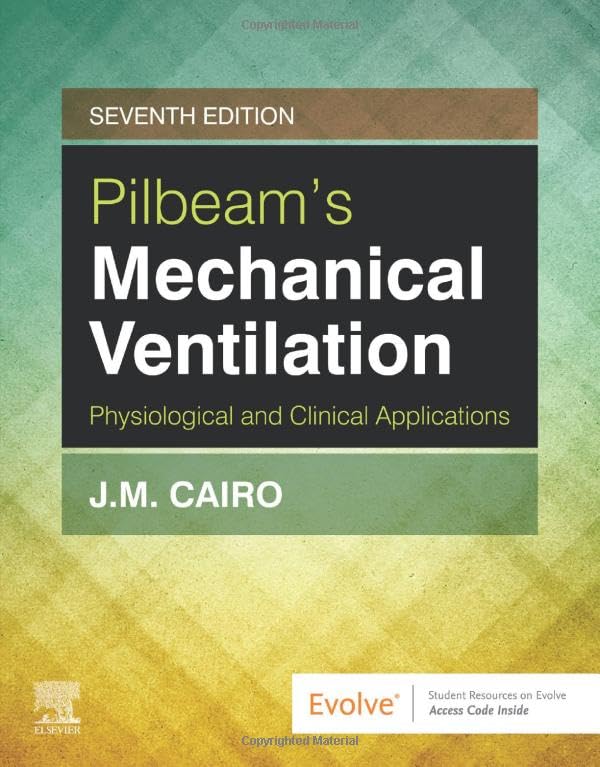
Pilbeam's Mechanical Ventilation Physiological and Clinical Applications Compiled by James M. Cairo
Material type: TextPublication details: Missouri Elsevier 2016Edition: 7th editionDescription: xvii, 555p ill, 27.5cmISBN:
 - 978-0323551274
- WF145.C37.2016
| Item type | Current library | Call number | Status | Date due | Barcode | |
|---|---|---|---|---|---|---|
 Books
Books
|
KMTC:KINANGOP CAMPUS General Stacks | WF145.C37.2016 (Browse shelf(Opens below)) | Available | KIN/0160 | ||
|
Books
|
KMTC:MWINGI CAMPUS General Stacks | WF145.C37.2016 (Browse shelf(Opens below)) | Available | MWG/1620 | ||
|
Books
|
KMTC:MWINGI CAMPUS General Stacks | WF145.C37.2016 (Browse shelf(Opens below)) | Available | MWG/1621 |
Shelving location: General Stacks Close shelf browser (Hides shelf browser)
| No cover image available No cover image available |

|
|
|

|
|
|
||
| RT41.L48.2014 MEDICAL SURGICAL NURSING 12 Sections | WF145.C37.2016 Pilbeam's Mechanical Ventilation Physiological and Clinical Applications | WF145.C37.2016 Pilbeam's Mechanical Ventilation Physiological and Clinical Applications | WF145.C37.2016 Pilbeam's Mechanical Ventilation Physiological and Clinical Applications | HG9386..5 .B45 2021 HEALTH INSURANCE TODAY A PRACTICAL APPROACH | HG9386..5 .B45 2021 HEALTH INSURANCE TODAY A PRACTICAL APPROACH | HG9386..5 .B45 2021 HEALTH INSURANCE TODAY A PRACTICAL APPROACH |
previously published as 6th edition in 2015
Pilbeam's, S. P. (2021). Pilbeam's mechanical ventilation: Physiological and clinical applications (7th ed.). Elsevier.
Introduction to Mechanical Ventilation – Overview of mechanical ventilation and its clinical applications.
Ventilator Basics – Principles of mechanical ventilation, modes, and settings.
Patient Ventilator Interactions – Monitoring patient response and troubleshooting.
Ventilator Graphics – Understanding waveforms and loop diagrams.
Pulmonary Mechanics – Concepts of lung compliance, resistance, and airway pressures.
Specialized Ventilation – Use of mechanical ventilation in pediatric, neonatal, and bariatric patients.
Ventilator-Associated Complications – Identifying and managing complications like VAP (Ventilator-Associated Pneumonia).
Weaning and Extubation – Approaches to weaning patients off ventilation.
Capnography and Blood Gas Interpretation – Assessing ventilator performance with capnography and interpreting ABGs.
Pilbeam's Mechanical Ventilation, 7th Edition is a comprehensive guide to the principles and clinical applications of mechanical ventilation. It covers essential topics such as ventilator modes, settings, and patient-ventilator interactions. The book emphasizes understanding pulmonary mechanics, ventilator graphics, and the management of ventilator-associated complications like VAP. Special sections focus on ventilation for pediatric, neonatal, and bariatric patients, as well as strategies for weaning and extubation. It also includes guidance on using capnography and interpreting blood gases to assess ventilator performance. This resource is designed for healthcare professionals to safely and effectively manage mechanical ventilation in clinical settings.
There are no comments on this title.