
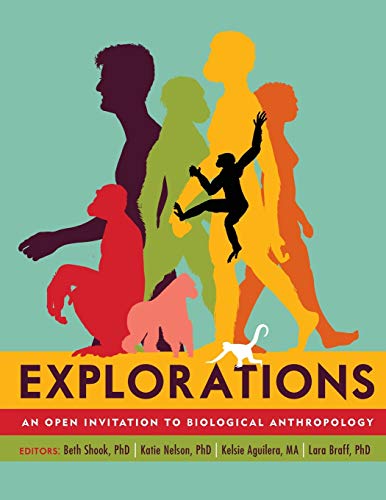
Explorations An Open Invitation To Biological Anthropology Beth Shook
Material type: TextSeries: Open textbook libraryDistributor: Minneapolis, MN Open Textbook LibraryPublisher: [Place of publication not identified] American Anthropological Association 2023Copyright date: ©2023Edition: 2nd EditionDescription: 1 online resourceContent type:
 - text
- computer
- online resource
- 9781931303637
- QH308.2
- H1
- GN25
Preface -- Dedication -- Instructors' Guide for Explorations -- Chapter 1: Introduction to Biological Anthropology -- Chapter 2: A History of Evolutionary Thought -- Chapter 3: Molecular Biology and Genetics -- Chapter 4: Forces of Evolution -- Chapter 5: Meet the Living Primates -- Chapter 6: Primate Ecology and Behavior -- Chapter 7: Stones and Bones: Studying the Fossil Record -- Chapter 8: Primate Evolution -- Chapter 9: Early Hominins -- Chapter 10: Early Members of the Genus Homo -- Chapter 11: Archaic Homo -- Chapter 12: Modern Homo sapiens -- Chapter 13: Race and Human Variation -- Chapter 14: Human Variation: An Adaptive Significance Approach -- Chapter 15: Forensic Anthropology -- Chapter 16: Contemporary Topics: Human Biology and Health -- Chapter 17: Social and Biopolitical Dimensions of Evolutionary Thinking -- Appendix A -- Appendix B -- Appendix C -- Appendix D
Anthropology is the study of humanity, in all its biological and cultural aspects, past and present. It is a four-field discipline comprised of biological anthropology, cultural anthropology, archaeology, and linguistic anthropology. The focus of this book is biological anthropology, which explores who we are from biological, evolutionary, and adaptive perspectives. We lay the foundation for this inquiry in the first four chapters by introducing the discipline of anthropology, evolutionary theory, molecular biology and genetics, and the forces of evolution. What's New in the 2nd Edition? Two new chapters; More concise chapters (8,000 to 10,000 words, not including call out boxes); Updated chapters with new discoveries and events; Diversity, equity and inclusion principles applied to the text and images; Enhanced accessibility standards reviewed by the ASCCC-OERI; Instructor guide detailing how to adapt the book to better fit your course. Student reviewed content.
Attribution-NonCommercial
In English.
Description based on print resource
There are no comments on this title.